
Acoustic Birefringence
for Measuring Rail
Neutral Temperature
Enhanced Acoustic Birefringence Method for Measuring Longitudinal Rail Stress — research summary from Analogic Engineering, Inc.
0.8 °F
Avg. RNT Error
1.9 KIP
Avg. Force Error
R² = 99.9%
AB–Stress Linearity
Methodology
Research Approach
Our research is based on using an ultrasonic stress measurement technique known as Acoustic Birefringence (AB) to measure the longitudinal stress in the rail. At the current level of development, a stress-free AB calibration is required. Future measurements of AB at the same location can then be used to measure LRS and calculate RNT with an accuracy better than the industry target benchmark of ±5 °F. AEI refers to this stage of technology as achieving Relative RNT measurement.
01
Existing AB Instrumentation
Started with acoustic birefringence instrumentation developed under prior NSF SBIR work as the foundation for the FRA project.
02
Rail Stress Test Fixture
Designed and built a fixture that simulates thermally-induced stress up to 165 KIP in both tension and compression, using NIST-traceable load cells as the force reference.
03
Nine-Rail Calibration Study
Tested nine sample rails across the full load range and established a linear AB–stress relationship with R² = 99.9%.
04
Field Validation at TTC
Validated against strain-gauge instrumented rail on the High Tonnage Loop at the Transportation Technology Center, plus a residual stress survey on three 80-ft loose rail strings.
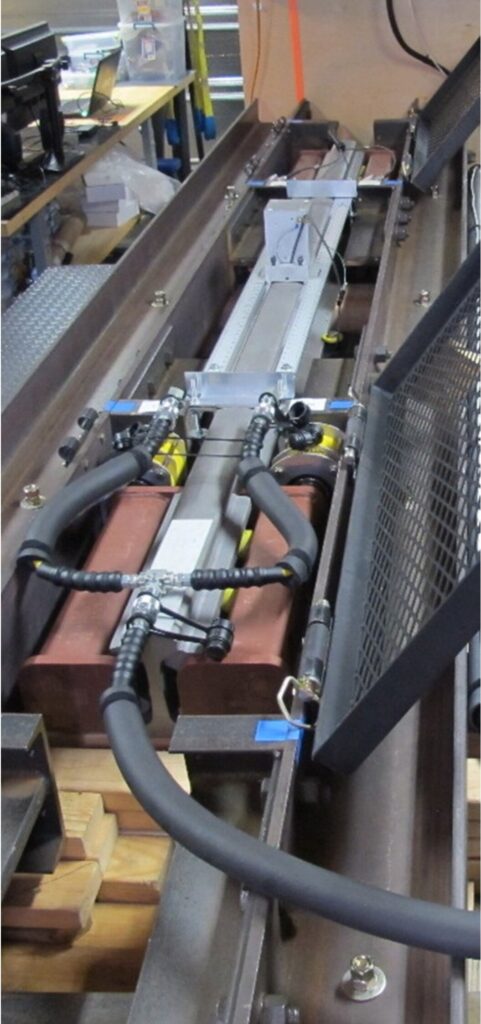
Rail Stress Test Fixture — 165 KIP tension/compression
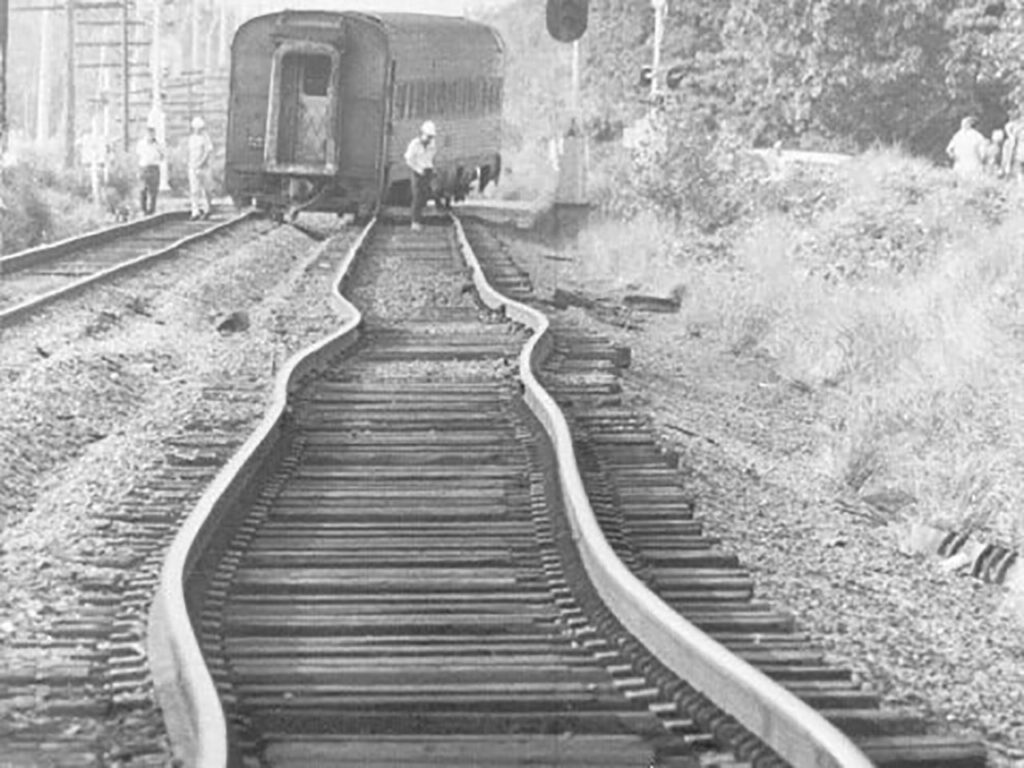
Technology
How It Works
Rail-Specific EMAT Transducer
Phased-array Electromagnetic Acoustic Transducer determines fast/slow shear-wave polarization angles, with optimized aperture and beam shape for the top of rail. Web and under-foot configurations available for fixed installations.
Custom Instrumentation & Signal Processing
Time-of-flight measurement to billionths of a second, recovering signals from below the noise floor for repeatable acoustic birefringence measurements.
Rail Alignment Guide
Mechanical guide developed during the project to ensure accurate, repeatable lateral alignment of the EMAT transducer on the rail head.
Non-Destructive & Non-Hazardous
Ultrasonic waves remain fully contained within the rail volume. No cutting, drilling, or significant track preparation required — measurement time of 10–20 minutes per rail.
Validation
Field Test Results
In-situ measurements on the High Tonnage Loop at the Transportation Technology Center (TTC), Pueblo, CO, compared against a strain-gauge instrumented rail section over the course of November 14, 2019.
Longitudinal Rail Force
TTC Strain Gauge vs. Acoustic Birefringence
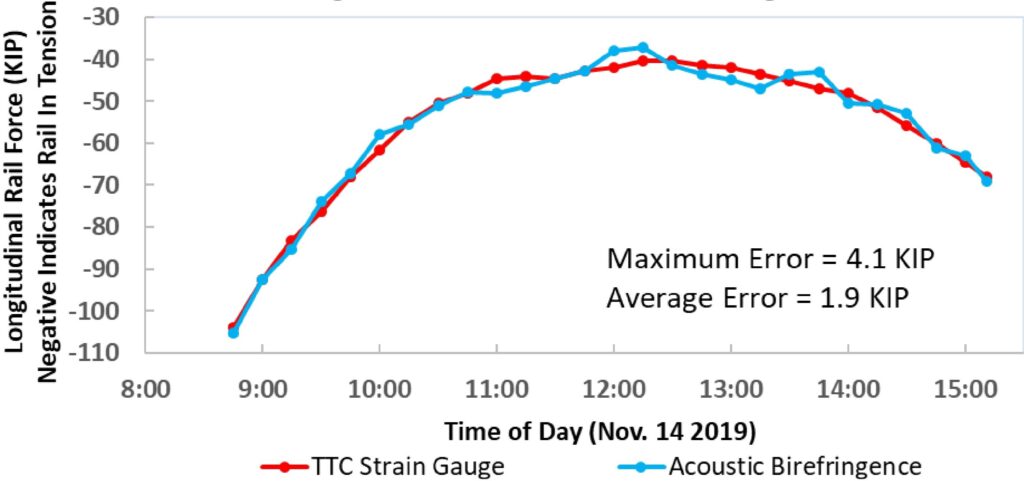
Maximum Error
4.1 KIP
Average Error
1.9 KIP
Rail Neutral Temperature
TTC Strain Gauge vs. Acoustic Birefringence
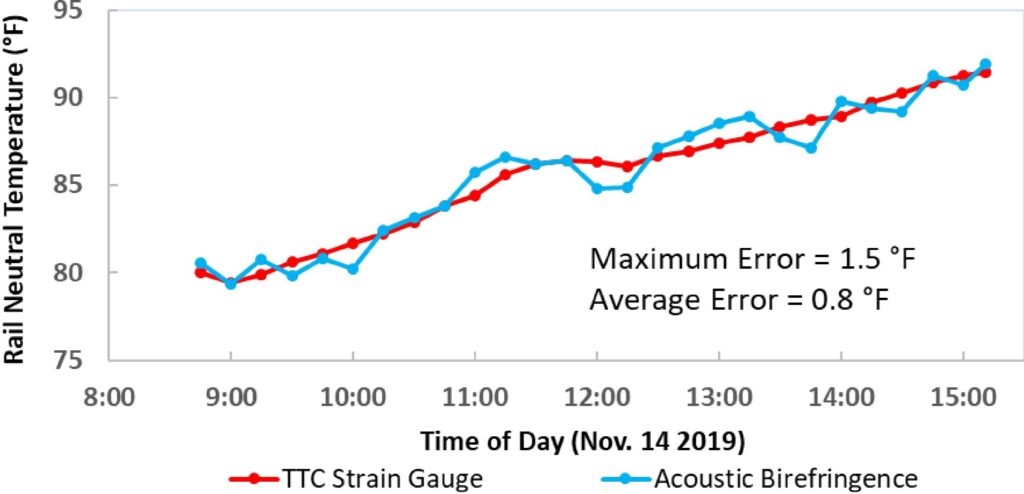
Maximum Error
1.5 °F
Average Error
0.8 °F

Project Findings
Key Questions Answered
Technology Type
Acoustic Birefringence (AB) using a rail-specific EMAT phased-array transducer, custom time-of-flight instrumentation, and a mechanical rail alignment guide.
Reference-Free?
Not at present — initial calibration to a known longitudinal stress is required. A reference-free approach is plausible as a future goal through additional research surveying loose-rail residual stress patterns.
Spot or Moving Platform?
Spot measurement. Suitable for fixed-location devices and portable field instruments for rail repair and RNT adjustments. A moving (Hi-Rail) platform is unlikely due to required precision.
Risks to Commercialization
Minimal for relative stress measurement — research phase complete, lab and field results show < 5 °F RNT error contribution. Method is non-hazardous, non-destructive, and requires no significant site preparation.
Track Configurations & Conditions
No significant impact anticipated. Ultrasonic waves are fully contained within the rail volume; no unexpected influences observed in field testing. Minor considerations: alignment guide requires upper-web access and excess surface contamination should be avoided.
Field Testing to Date
In-situ rail test at TTC compared against an HTL section instrumented with strain gauges, plus a residual stress survey along selected sections of three 80-ft loose rail strings.
“You can’t fix what you haven’t measured.” — Engineer’s motto guiding this research.
Path Forward
From Research to Application
Relative Stress Measurement
Technology validated and ready to proceed to product and application development. A proposal to the FRA includes prototype development of a fixed-location device.
Absolute Stress Measurement
Develop an automated tool to map residual stress in loose rail and build a comprehensive database of residual stress patterns across CWR rail weights and manufacturers.
Continued Research
What’s Next?
Additional research is required to provide Absolute measurements of rail stress, so that Rail Neutral Temperature (RNT) can be measured without the need for prior stress-free calibration. The requirement for prior stress-free calibration is due to the seemingly random AB variation that exists along most of the rail samples tested. Now we need to determine if AEI’s technology can be further developed to overcome the AB variation, eliminate stress-free calibration, and provide absolute RNT measurement.
AEI recommends several avenues for continued research, mostly aimed at overcoming the remaining hurdle of requiring stress-free calibration. In the interim, it may be worth considering developing applications for the current level of this technology, which has demonstrated that relative RNT measurements are already feasible. A device can be built to act as a virtual strain gauge that could be placed on stress-free rail, then read the RNT value as the rail is hydraulically pre-stressed in preparation for the closure weld. This could be used to verify the correct RNT for newly laid rail, after rail repairs, or if the rail has been cut for other maintenance purposes. If the stress-free AB value is recorded, future measurements of RNT can be made at that location. This data would also contribute to the database of AB measurements for ongoing analysis and improvement.